
AI Business Transformation for SMBs in Hyderabad | Digionomy AI Guide
AI business transformation, AI automation Hyderabad, AI systems India, AI business systems Hyderabad, AI automation company India
AI Business Transformation: A Complete Guide for SMBs in Hyderabad
As a senior software engineer who has helped Indian businesses deploy AI systems end to end, I can tell you this: for small and mid-sized businesses in Hyderabad, AI is no longer a “nice to have”. It is quickly becoming the operating system of modern business itself.
Why Hyderabad Is Becoming a Hub for AI-Powered Businesses
Telangana’s economy is growing at over 10.7% GSDP, with services expanding by 13.5% in FY 2025–26, outpacing the national average. Hyderabad is at the centre of this surge, driven by IT, Global Capability Centres (GCCs) and a rapidly evolving SMB ecosystem (HyderabadMail).
The city now hosts 350–400 GCCs, employs over 3 lakh professionals, and accounts for nearly half of new GCC setups in India (Economy of Hyderabad). Hyperscale data centres from Microsoft, AWS and Oracle are turning Hyderabad into one of India’s major AI infrastructure hubs, with live capacity jumping from 61 MW to over 151 MW and a 1.9 GW pipeline (Telangana Today).
For SMBs, this means three things:
Tech-forward culture: Your customers are already using AI in their phones, banks and workplaces. Their expectations of speed and convenience are rising every quarter.
Vibrant startup and GCC ecosystem: With AI innovation centres from firms like Tredence and The Hartford opening in the Financial District, AI talent and tools are more accessible than ever.
Fast-growing SMB sector: Credit to micro and small enterprises in Telangana has grown by over 22%, and office leasing in Hyderabad is up 20%+ year on year. Competition is intensifying. The SMBs that implement AI automation first will set the benchmark for everyone else.
📌 Key Takeaway: Hyderabad already has the infrastructure, talent and demand for AI. The missing piece for many SMBs is a clear, practical roadmap for AI business transformation.
The Four Stages of AI Business Transformation
At Digionomy AI, we look at AI business transformation as a four-stage journey. Whether you run a clinic in Banjara Hills, a logistics company in Bowenpally, or a manufacturing unit in Jeedimetla, the pattern is the same:
Awareness: Understanding what AI can realistically do for your business in India today, not in Silicon Valley case studies.
Assessment: Mapping your current processes, tools and data to identify quick wins and long-term opportunities.
Implementation: Deploying AI systems in a structured way across leads, operations, marketing and growth.
Optimisation: Continuously improving your AI models, prompts, workflows and data quality based on real-world performance.
Most SMBs in Hyderabad are stuck between Awareness and Implementation. They have bought a few tools, maybe tried a chatbot, but they do not yet have AI business systems. Let us change that.
Stage 1 — AI Lead Systems: Turn Attention into Appointments
The first layer of AI automation Hyderabad SMBs should focus on is AI Lead Systems. Your leads are already coming from WhatsApp, Instagram, phone calls and your website. The question is: how many are you silently losing?
WhatsApp AI: An AI agent that replies instantly, qualifies leads, answers FAQs in English, Hindi or Telugu, and books appointments directly to your calendar.
Chat AI on your website: Instead of a dead “Contact Us” form, a conversational assistant that guides visitors, captures details and triggers follow-ups.
Email automation: AI that drafts, personalises and schedules responses, nurture sequences and reminders based on lead behaviour.
Appointment booking: Automated calendar coordination so your team does not waste time on back-and-forth messages.
Technically, this is where we integrate AI with APIs from WhatsApp Business, Google Calendar and your CRM. For example, a simple Python-based webhook for a WhatsApp lead could look like this:
import requests
from datetime import datetime

def handle_whatsapp_lead(payload):
    phone = payload["from"]
    message = payload["text"]["body"]

    # 1. Send message to AI model for intent + qualification
    ai_response = requests.post(
        "https://api.openai.com/v1/chat/completions",
        headers={"Authorization": "Bearer YOUR_KEY"},
        json={
            "model": "gpt-4o-mini",
            "messages": [
                {"role": "system", "content": "You are a sales assistant for a Hyderabad clinic."},
                {"role": "user", "content": message}
            ]
        }
    ).json()

    reply_text = ai_response["choices"][0]["message"]["content"]

    # 2. Log lead in CRM
    requests.post(
        "https://your-crm/api/leads",
        json={"phone": phone, "message": message, "source": "WhatsApp"}
    )

    # 3. Trigger WhatsApp reply via provider API
    requests.post(
        "https://whatsapp-provider/api/messages",
        json={"to": phone, "text": reply_text}
    )

    return {"status": "ok", "timestamp": datetime.utcnow().isoformat()}
You do not need to write this code yourself—that is our job as your AI automation company in India. But it is important that your AI lead systems are integrated, not isolated bots.

AI lead systems capture, qualify and book appointments before your team even logs in.
Stage 2 — AI Business Systems: Automate the Back Office
Once leads are flowing, the next step is building AI business systems Hyderabad companies can rely on daily. This is where most of the real efficiency gains come from.
Workflow automation: Automatically move tasks from lead to quote to invoice to follow-up, with AI filling in repetitive details and drafting documents.
CRM infrastructure: A single source of truth for contacts, deals, communication history and support tickets, enriched by AI summaries and scoring.
Task management & scheduling: AI that assigns tasks to the right team member, estimates effort and reminds people before things slip.
A simple automation for task creation from new leads might look like this in pseudocode:
def on_new_lead(lead):
    # AI estimates deal size and urgency
    score = ai_score_lead(lead)

    assignee = "sales_rep_1" if score > 80 else "sales_rep_2"

    create_task(
        title=f"Call {lead['name']} ({lead['phone']})",
        assignee=assignee,
        due_date=today_plus_hours(4),
        metadata={"score": score, "source": lead["source"]}
    )
When you connect these automations across your tools—CRM, billing, project management—you start to feel the difference: fewer missed follow-ups, cleaner data and a calmer team.
Stage 3 — AI Marketing Systems: Always-On Demand Generation
With your internal operations stabilised, the next layer is AI Marketing Systems. This is where AI helps you compete with much larger players in Meta ads, Google ads, content, SEO and analytics—without hiring a huge marketing team.
Meta & Google Ads: AI-generated ad copy and creatives, automated A/B testing and budget reallocation based on performance.
Content & SEO: Topic research, article drafts, localised landing pages (e.g., “AI automation Hyderabad”, “AI systems India for logistics”) and metadata at scale.
Analytics: AI-written summaries of what happened this week—what worked, what did not, and where to focus next.
For example, you can use AI to generate multiple ad variations programmatically:
def generate_ad_variations(product, city="Hyderabad"):
    prompt = f"""
    Write 5 high-converting Facebook ad headlines and primary texts
    for a {product} targeting SMB owners in {city}.
    Emphasise AI automation, time savings and growth.
    """
    response = call_ai_model(prompt)
    return parse_ads(response)
Instead of guessing what might work, you let AI generate and test variations—while you retain control over strategy and brand voice.
Stage 4 — AI Growth Systems: Reactivation, Retention, Reputation, Reporting
The final layer is where your AI business transformation becomes self-funding. AI Growth Systems focus on maximising the value of the customers you already have.
Database reactivation: AI segments old leads and customers, then sends highly personalised WhatsApp, SMS or email campaigns to bring them back.
Retention: Intelligent reminders, renewal nudges and cross-sell suggestions based on behaviour and purchase history.
Reputation: Automated review requests after positive interactions, AI-drafted responses to feedback on Google and Justdial.
Reporting: Weekly and monthly AI-generated reports that tell you, in plain language, how your AI systems are performing.
For example, an AI summary report might be generated with a prompt like:
def generate_weekly_growth_report(metrics):
    prompt = f"""
    You are a business analyst for an SMB in Hyderabad.
    Using this JSON metrics data, write a clear 1-page report:
    - Key wins
    - Issues / risks
    - Recommended actions for next week

    Data:
    {metrics}
    """
    return call_ai_model(prompt)
This is where leadership gains true visibility and control over an increasingly complex, AI-augmented operation.

Growth systems turn your existing database into a predictable, AI-managed revenue engine.
When All Four Systems Run Together: Your AI Business Operating System
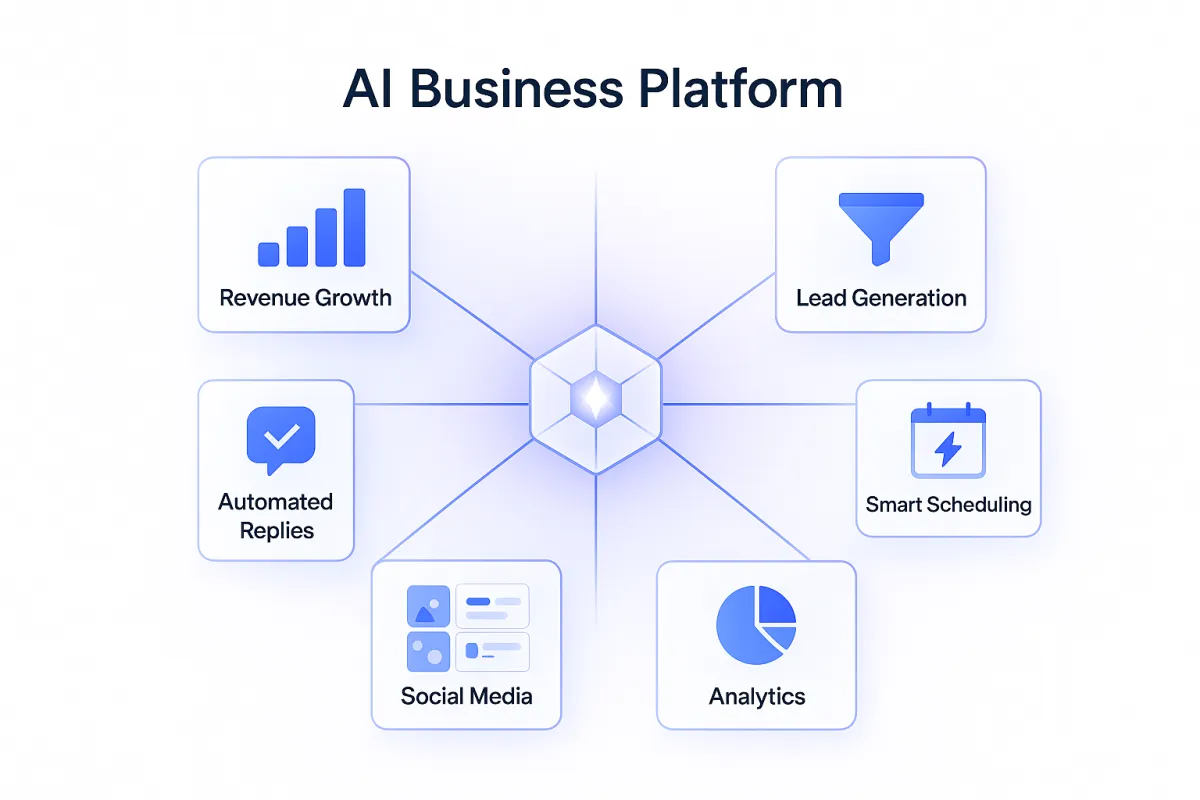
When AI Lead, Business, Marketing and Growth systems are integrated, you effectively create a complete AI business operating system for your Hyderabad SMB:
Leads from Meta ads, Google searches and referrals enter through AI chat and WhatsApp.
Qualified prospects are logged in your CRM, assigned to team members and followed up automatically.
Operations, tasks, billing and service delivery are orchestrated by workflows that minimise manual effort and errors.
Marketing campaigns are continuously tested and refined by AI, feeding more leads into the system at lower cost per acquisition.
Existing customers are reactivated, retained and encouraged to leave reviews, compounding your brand presence in Hyderabad and across India.
From a systems-engineering perspective, this is a network of AI agents and automations, orchestrated with human oversight at key decision points. It is not about replacing people; it is about giving your people an intelligent exoskeleton so they can do more, with less stress.
Common Mistakes SMBs Make When Implementing AI
After working with multiple AI business systems in India, I see the same patterns repeatedly:
Buying tools instead of systems: A chatbot here, an email tool there, a CRM somewhere else—none of them talking to each other. Result: more complexity, not more growth.
No integration: Data sits in silos—your WhatsApp leads are not in your CRM, your website forms are not triggering workflows, your marketing is blind to operations capacity.
No optimisation loop: AI models and prompts are treated as “set and forget”. There is no regular review of performance, no fine-tuning, no experimentation.
💡 Pro Tip: Think of AI like hiring a team of junior staff. If you do not train, monitor and refine their work, you will not get the results you want.
The Digionomy AI Approach: 75% AI, 25% Human Oversight
Digionomy AI is built around a simple principle: let AI do the heavy lifting, and let humans make the important calls. In practical terms, that means:
75% AI: Automated data capture, drafting, routing, scoring, scheduling and reporting across your four system layers.
25% human oversight: Your team (and ours) review edge cases, refine prompts, approve key communications and adjust strategy.
Critically, we build a continuous optimisation loop into every deployment:
Measure performance weekly (conversion rates, response times, task completion, campaign ROI).
Review AI outputs and user feedback to identify failure patterns or friction points.
Update prompts, workflows and configurations; re-test and repeat.
This is how large enterprises and GCCs in Hyderabad are treating AI today—as a living system, not a one-time project. SMBs deserve the same standard, adapted to their size and budget.
How to Get Started: Three Simple Steps for Hyderabad SMBs
If you are ready to explore AI automation Hyderabad style—grounded, practical and locally relevant—here is the simplest way to begin with Digionomy AI:
Book a free AI Strategy Session: A focused conversation (online or in-person in Hyderabad) with our senior team to understand your current systems, goals and constraints. No jargon, no fluff—just clear mapping of where AI can help.
Get a custom AI roadmap: We design a phased plan across the four stages—Lead, Business, Marketing and Growth systems—tailored to your sector, team size and budget. This includes recommended tools, integrations and KPIs.
Implement and optimise: Our engineers and consultants work with your team to deploy, integrate and refine your AI systems, with ongoing optimisation baked in from day one.
Whether you are just starting with AI or looking to upgrade from scattered tools to a coherent AI operating system, this three-step path gives you structure and momentum.
Your Next Move: Build the AI Backbone of Your Business
Hyderabad is moving fast. GCCs are investing heavily in AI, public sector projects are deploying AI infrastructure, and your customers are becoming more digital every month. The question is not “Will AI impact my business?” but “Will I design that impact, or react to it?”
With a structured approach to AI business transformation, you can:
Respond to every lead in seconds, 24/7.
Run operations with fewer errors and less manual firefighting.
Compete with larger brands in marketing, without matching their headcount.
Turn your existing customer base into a predictable source of recurring revenue and referrals.
If you are an SMB owner in Hyderabad or Telangana and you want an AI automation company India that understands both cutting-edge technology and local business reality, Digionomy AI was built for you.
🚀 Strong Call to Action: Book your free AI Strategy Session with Digionomy AI today. In 60–90 minutes, we will help you see exactly how AI lead systems, AI business systems, AI marketing systems and AI growth systems can work together for your specific business in Hyderabad—so you can move from curiosity to concrete action.

One strategy session can define the AI backbone of your business for years.


